Saigon Markets Tour: Ben Thanh and the Other Markets, Compared
Saigon's markets are not seven versions of the same afternoon. Two of the best are wholesale halls out in Cholon, 3 to 6 km west of the centre; one trades flowers through the night in District 10; one is an air-conditioned shopping building; and one is a pair of streets where the stalls may or may not be up tonight. This page compares them on the things that actually decide a morning — where each one is, when it opens, what it is for, how long it takes — gives a verdict on each, and then walks one route that puts four of them into a single day.
A note on the districts before the table. HCMC abolished its district-level units on 1 July 2025, so the address on the door of every market below is a ward now, not a district. Everyone in the city still says District 1 or District 5, and so does this page. One correction the older versions of this page carried: Binh Tay is in District 6, not District 1, An Dong is in District 5, and Ho Thi Ky is in District 10.
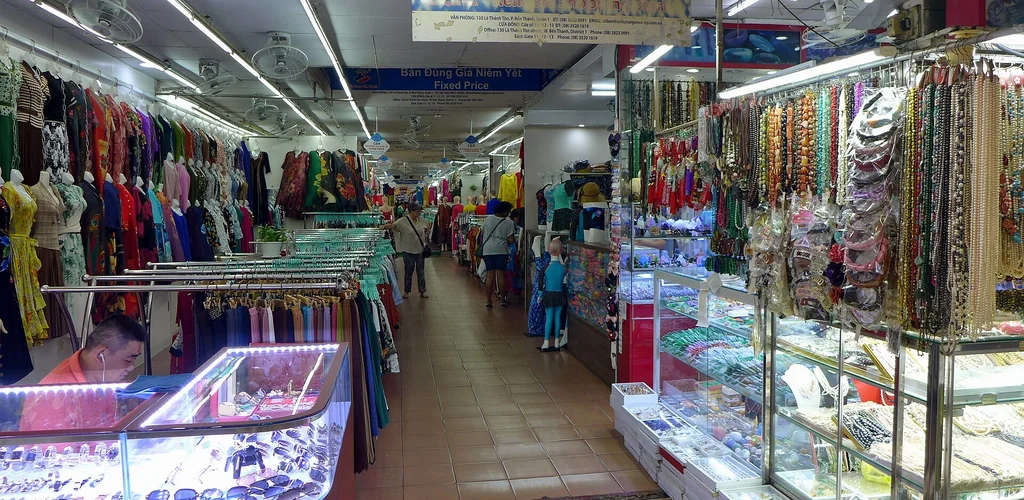
Photo: Bahnfrend, CC BY-SA 4.0, via Wikimedia Commons
The Six Markets and One Street, Side by Side
Time to allow is our estimate, not a published figure. Hours come from named sources, and where there is no source this page prints no figure.
| Market | District | Hours | What it is for | Time to allow | Go if · skip if |
|---|---|---|---|---|---|
| Ben Thanh | 1 | 6:00 AM–6:00 PM, day hall | Souvenirs, coffee, lacquerware, áo dài fabric, and a sit-down food hall | 1.5–2 hours | Go for one market you can walk to from the centre, or for lunch in the hall. Skip if you are buying cloth by the metre or buying by the dozen. |
| Tan Dinh | 1 | Early morning–6:00 PM | Áo dài fabric, and the tailors who make the garment | 45 minutes–1 hour | Go if you want cloth and a tailor in one building. Skip if you want souvenirs, air-conditioning or a big hall. |
| An Dong | 5, Cholon | 7:00 AM–6:00 PM; some food stalls later | Clothing and fabric in quantity, at wholesale rates from three pieces | 1.5–2 hours | Go if you are buying three of the same thing, or fabric for a suit. Skip if you want one souvenir and a vendor who speaks English. |
| Binh Tay | 6, Cholon | About 6:00 AM–6:00 PM; trade peaks 6:30–10:30 AM | Wholesale spices, dried seafood, Chinese herbs, ceramics and fabric | 1–1.5 hours | Go for the Cholon market and wholesale prices. Skip if you cannot carry a box, or you need air-conditioning. |
| Ho Thi Ky | 10 | 24 hours; busiest before dawn | Cut flowers by the bunch, and the food street alongside | 30–45 minutes, before dawn | Go if you are awake at 3 AM, or you want the food street. Skip if you were planning it for the afternoon — the flower trade is over by then. |
| Saigon Square | 1 | 9:00 AM–9:00 PM daily | Air-conditioned fashion, accessories and electronics, at lower markups | 45 minutes–1 hour | Go if you want to shop in air-conditioning and still bargain. Skip if you want handicrafts or a market. |
| Evening street stalls (Ben Thanh) | 1 | No published closing time | The after-dark extension of Ben Thanh, when it is there | 15–20 minutes to walk both sides | Go if you are in the centre after dark and want to see for yourself. Skip if you are building an evening around them. |
A Verdict on Each
Ben Thanh: the one to do if you only do one
It is the only market on this list with a metro station at its door — Bến Thành station sits under Quách Thị Trang Square in front of the South Gate, and its exit 3 comes up on Phan Chu Trinh beside the West Gate — and the most central of the traditional halls; its food hall, Ô 4C, sits inside Area IV. It is also the most expensive: prices here are retail and aimed at visitors, and the opening quote sits well above the number that settles. About 1,500 stalls in four numbered areas, under fans rather than air-conditioning. One morning in Saigon, one market, no taxi: this is it. One morning, and you came for cloth: it is not.
Which Gate to Use at Ben Thanh Market: the operator publishes no per-gate trade list, so the four gates decide the street you arrive on and the landmark you meet, not what you shop for. The South Gate is Cửa Nam, on Lê Lợi beside Quách Thị Trang Square, under the clock tower; the East Gate is Cửa Đông, on Phan Bội Châu, where evening street stalls go up when they are there; the West Gate is Cửa Tây, on Phan Chu Trinh, where Metro Line 1's Bến Thành station exit 3 (lối số 3) comes up beside the market. What is sold where follows the operator's block numbering — Khu vực I–IV and their Ô sub-blocks, every stall displaying its number — and the eating area is Ô 4C inside Khu vực IV. The North Gate is Cửa Bắc, on Lê Thánh Tôn at door number 9, and its frontage is the one the operator's zoning names goods for: fruit, fresh flowers and artificial flowers. Our gate-by-gate guide to Ben Thanh Market takes each door in turn.
Food Court Excellence: Ben Thanh Market's food court serves as a culinary gateway to Vietnamese cuisine. Popular dishes include authentic Pho (beef noodle soup) for 50,000-120,000 VND, fresh Banh Mi sandwiches for 25,000-40,000 VND, and traditional Vietnamese iced coffee for 25,000-40,000 VND. For the evening stalls that go up, when they are there, on Phan Bội Châu and Phan Chu Trinh, see what we can and cannot say about the night market.
Tan Dinh: fabric and a tailor, not a souvenir arcade
Cloth is what people come here for. Tuoi Tre reported in September 2026 that visitors from Malaysia, Indonesia, India and China come to Tan Dinh for fabrics, fashion and tailoring, that stalls at Tan Dinh and Ben Thanh have expanded their on-site tailoring for áo dài and áo bà ba, and that foreign visitors make up 70–80% of the customers using those services. That is a working District 1 market with a tailoring trade attached, on Hai Ba Trung about 3 km west of Ben Thanh — not a tourist hall, and not a place to buy a magnet.
The building is not air-conditioned: it is cooled by louvered windows and vents under a high vaulted roof, which is the honest description of a French-era market hall in this climate. It closes at 6:00 PM, and the closing hour is the one thing every source agrees on; the opening is reported anywhere from 5:00 to 7:00 AM, so treat "early morning" as the plan and do not build a schedule around a 6:00 AM start.
We print no price level for Tan Dinh. The published views contradict each other — one state-media history calls it the market of the rich, on relatively high prices, while a guide says its prices have come down to match other markets — and nothing compares it with Ben Thanh at all. A number with nothing behind it is worse than no number, so the comparison is left out rather than guessed.
An Dong: Cholon's clothing trade, by the piece or the carton
This is the trade market: it supplies clothing and fabric shops across southern Vietnam, which is why the base price sits closer to wholesale than anything in District 1, and why the stock turns over faster than a tourist hall's. Fabric by the metre runs 80,000–300,000 VND (cotton and blends from about 80,000, silk and lace 150,000–300,000), and ready-to-wear runs 50,000–250,000 a piece with the better stock above that. Single pieces are sold, but at retail; three or more of the same item, or a full carton, is what unlocks the wholesale rate, and that rate is quoted at the counter rather than printed.
Plan for the friction. Most stalls are cash only, vendors have noticeably less English than at Ben Thanh, returns and exchanges are not part of how the market works, and the building is air-conditioned in some areas and on the upper floors rather than throughout. It is at its fullest from about 9:00 AM and quietens after 4:00 PM. There is no metro anywhere near it: Line 1's nearest station is Ben Thanh, the last 3 to 4 km is by road, and the ride is about 15 minutes when traffic is clear for 50,000–90,000 VND, typically around 60,000.
Binh Tay: the wholesale engine of Cholon
About 2,300 stalls over two levels, on a site of about 25,000 m², built between 1928 and 1930 on money put up by the Chinese merchant Quach Dam, whose bust stands in the central courtyard. The upper floor is confectionery, sweets and ready-made clothing; the ground floor and the Tháp Mười frontage are ceramics, household goods, votive goods, hats, bags, shoes and jewellery, with the dried spices; the dried seafood and dried-goods stalls run along the Lê Tấn Kế side; and the fresh wet market — meat, fish, vegetables and herbs — is outside, at the rear on Phan Văn Khỏe. Prices are wholesale and land roughly 30–50% below Ben Thanh retail, which is the whole reason to make the trip — the catch is that stalls sell by the box, the dozen or the metre far more often than by the single item.
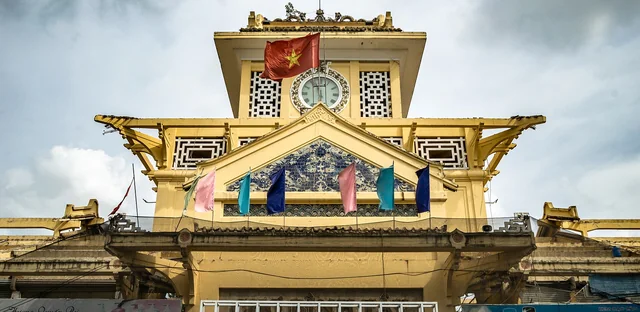
Photo: Alexander Synaptic from Taipei, Taiwan, CC BY-SA 2.0, via Wikimedia Commons
Go early. Wholesale trade peaks between 6:30 and 10:30 AM and the hall is noticeably quieter by midday, which is the opposite of how Ben Thanh behaves. There is no air-conditioning: ceiling-mounted industrial fans run the length of the hall, and it is at its hottest around midday. No metro station either — a Grab or taxi from District 1 is 15–20 minutes and 30,000–50,000 VND over about 5–6 km.
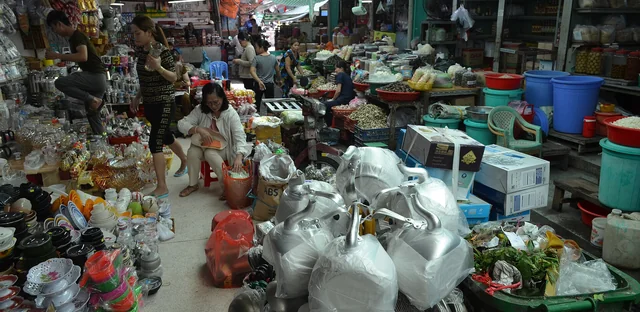
Photo: Nick, CC BY 2.0, via Wikimedia Commons
Ho Thi Ky: flowers before dawn, in District 10
The flower market never closes, but it has a shape. Fresh stock arrives from the growing regions overnight and the trade peaks in the pre-dawn hours — roughly 2:00 to 6:00 AM, with other sources putting the busiest stretch between midnight and 6:00 — and the daytime is the quiet window. So this is not an afternoon stop, and it is not a place to turn up at 11 AM expecting a market: by then you are looking at the leftovers of a trade that finished before breakfast. It is a set of narrow open-air alleys rather than a hall, no air-conditioning, about 3–4 km from Ben Thanh and 10–20 minutes by taxi or ride-hailing. The food street that runs alongside it is a draw in its own right.
Saigon Square: the air-conditioned one
It is the only stop on this list that is air-conditioned throughout. A shopping building rather than a market — fashion, accessories and electronics, under cover and cooled — it opens 9:00 AM to 9:00 PM daily, which makes it the one stop here you can still make after everything else has shut.
Two corrections to what you will read elsewhere. Prices run lower than Ben Thanh for comparable goods — that direction is well sourced, though no reliable percentage exists and we print none. And it is not fixed-price: eight independent sources describe negotiation as the norm there, with some stalls marked fixed, so treat the "fixed prices, credit cards" line you will find on other guides as wrong on the first half. What is true is that the room to negotiate is smaller than at Ben Thanh, because the opening ask is closer to the settling price.
The evening street stalls: check before you plan around them
The evening street stalls, when they are there, go up on Phan Bội Châu and Phan Chu Trinh, the two streets flanking the building, and have no published closing time: the operator says its managed night area has been suspended since the pandemic, while the city's tourism listing still gives a 7:00 PM start. Check on the ground before planning an evening around it. If they are up, treat them as a bonus on the way to dinner rather than as the destination.
One safety point worth knowing. The stalls sit on a roadway that traffic still uses: we could find no standing nightly vehicle ban on either street, only event-specific daytime closures for drills and parades, and the city's pedestrian-street plan for this block is a proposal, not an implemented scheme. Walk on the vendor side, not in the road.
One Day, Four Markets: the Route
The order is set by what each market does with its morning. Binh Tay opens at about 6:00 AM, and its wholesale trade is largely over by 10:30, so it wants the earliest start on this list. An Dong is at its fullest from about 9:00. Ben Thanh keeps its day window until 6:00 PM and has the food hall, which makes it the lunch stop. Tan Dinh closes at 6:00 PM, so it is last. From District 1, Binh Tay is a Grab or taxi of about 15–20 minutes and 30,000–50,000 VND over roughly 5–6 km.
The clock column is our worked plan, not a published timetable: it puts the opening hours above, the ride times below and the time-to-allow estimates onto a single timeline. The Binh Tay → An Dong leg is the one that can slip, and there is no published journey time for it.
| Stop | On the clock (our worked plan) | Ride to the next stop |
|---|---|---|
| Binh Tay (District 6) | 6:30–8:00 AM | No published ride time to An Dong — see the note below. |
| An Dong (District 5) | 9:00–10:45 AM | To Ben Thanh: about 15 minutes when traffic is clear, 50,000–90,000 VND, typically around 60,000. |
| Ben Thanh (District 1) | 11:15 AM–1:15 PM | To Tan Dinh: about 3 km, 10–15 minutes, 60,000–90,000 VND. |
| Tan Dinh (District 1) | 1:45–2:45 PM | None: it closes at 6:00 PM, and that is the end of the route. |
One leg of that route has no published journey time, and we are not going to invent one. Every figure we could find for the An Dong ride is measured from District 1, not from one Cholon market to the other. Binh Tay is in District 6 and An Dong in District 5, both inside the same quarter, so the hop between them is short — but if you want the plan to hold, leave Binh Tay by 8:00 and ask the driver for An Dong market at 34–36 An Duong Vuong, and let the meter tell you what the leg was.
None of the three western stops has a metro station. Line 1 opened on 22 December 2024 and runs east from Ben Thanh to Suoi Tien, 14 stations, none of them in District 5 or 6: the nearest station to An Dong is Ben Thanh itself, and the last 3 to 4 km is by road. Buses do serve the market — routes 06, 56 and 139 stop at An Dong market on An Duong Vuong — and from 1 July to 31 December 2026 fares on 134 city bus routes are waived, with identity verification required in the second phase. After 31 December 2026 a subsidised route costs 5,000–7,000 VND.
What to Pay at Each Market
There is no official price list to consult — Ben Thanh's operator says so itself — so what follows is the bargainable number, not an opening quote, for the goods we have checked; and where a market has no price we can stand behind, the table says so instead of filling the cell.
| Market | What you are buying | What to pay |
|---|---|---|
| Ben Thanh | Phở, in the food hall (Ô 4C) | 50,000–120,000 VND |
| Ben Thanh | Bánh mì | 25,000–40,000 VND |
| Ben Thanh | Cà phê sữa đá | 25,000–40,000 VND |
| Ben Thanh | Coffee, 500 g, standard packaged brands | From 80,000 VND |
| Ben Thanh | Genuine silk scarf | From 300,000 VND |
| Ben Thanh | Nón lá (conical hat) | 30,000–60,000 VND |
| Ben Thanh | Ready-made áo dài | 300,000–800,000 VND |
| Ben Thanh | Small souvenir (magnet, keyring) | 20,000–50,000 VND |
| Ben Thanh | Lacquerware box, small | From 80,000 VND (a small box or bowl runs 80,000–150,000) |
| An Dong | Fabric, per metre | 80,000–300,000 VND: cotton and blends from about 80,000, silk and lace 150,000–300,000 |
| An Dong | Ready-to-wear, per piece | 50,000–250,000 VND, with the better stock above that |
| Binh Tay | Everything on the floor | Typically 30–50% below Ben Thanh retail; sold by the box, the dozen or the metre |
| Tan Dinh | Fabric, tailoring | No price level printed: the sources contradict each other, so this page carries none |
| Ho Thi Ky | Cut flowers | No comparison printed: nothing compares its prices with the other markets |
| Saigon Square | Comparable goods | Lower than Ben Thanh — direction only, no percentage is sourced |
| Evening stalls | Souvenirs and confectionery | No comparison printed: nothing compares evening stall prices with the daytime hall |
The Ben Thanh figures are the numbers in our Ben Thanh Market price guide, which also carries the bargaining method — open low, settle below the first quote, and do not apply the souvenir-aisle percentages to the food hall, which is fixed-price. At An Dong and Binh Tay the arithmetic is different: the discount comes from quantity, not from haggling, so the question to ask is what the wholesale rate is on three pieces, not what the best price is on one.
Two pieces of paper to hold a vendor to. The market's own rulebook requires every stall to display its price and to charge the price displayed (Nội quy chợ, Điều 9.2), which makes the listed figure the thing you measure a quote against; and every stall is required to display its number (Điều 9.5), so a price agreed at a numbered stall in Ô 1A is a price you can come back to, send someone else to, or complain about.
The Short Answers
Can I do three markets before lunch?
Yes, and it is the route above: Binh Tay at 6:30, An Dong from 9:00, Ben Thanh by about 11:15 in time for the food hall. It works because the two Cholon markets are on the same side of the city and Ben Thanh is 15 minutes back towards the centre. What breaks it is a late start: the wholesale trade at Binh Tay is mostly done by 10:30, so an 8:30 arrival there pushes everything back and you end up doing two markets, not three.
Which market should I go to for fabric?
An Dong, if you want fabric by the metre from about 80,000 VND with silk and lace at 150,000–300,000, and the wholesale rate from three pieces. Tan Dinh, if the errand is an áo dài, because the fabric and the tailors are in the same building. Ben Thanh sells fabric as well, in blocks Ô 1A and Ô 2A, but you are paying retail for the convenience of not leaving District 1.
Are any of these markets air-conditioned?
Saigon Square is, throughout, and it is the only one. An Dong is indoors and air-conditioned in some areas and on the upper floors, not throughout. Ben Thanh has fans rather than air-conditioning. Binh Tay has no central air at all — ceiling-mounted fans down the aisles, and the hall at its hottest around midday. Tan Dinh is cooled by louvered windows and vents under a high roof. Ho Thi Ky is a set of open alleys.
Is the Ben Thanh night market running?
Nobody has settled it, and this page will not pretend otherwise. The market's management board told Tuoi Tre in December 2025 that trade at the market is almost entirely daytime, running to about 19:00 or 20:00, and that the small outdoor night area the authorities used to run has been suspended since the pandemic. Against that, the city's Department of Tourism still lists the Ben Thanh night market among the city's night-tourism clusters in a field survey published in March 2026, and the city's own tourism listing gives a 7:00 PM start. What is not in dispute: the stalls, when they are there, are on Phan Bội Châu and Phan Chu Trinh, the two streets flanking the building, and no source gives a closing time you can plan on. Ask at your hotel, or walk past after dark and look.
What does a day of rides cost?
From District 1: about 15–20 minutes and 30,000–50,000 VND to Binh Tay; about 15 minutes and 50,000–90,000 VND between Ben Thanh and An Dong; about 10–15 minutes and 60,000–90,000 VND to Tan Dinh. The metro covers none of this except Ben Thanh, where Line 1's Bến Thành station is at the market's edge on Quách Thị Trang Square. Cash is the default in the markets, so break a large note before you go in.
I have one morning, not a day. Which market?
Ben Thanh, unless you came to Saigon to buy cloth or clothes. It is central, walkable, and 90 minutes gets you the hall, a coffee and a lacquerware box without a taxi. If the errand is fabric or a tailor, spend the morning at Tan Dinh (3 km, closes at 6:00 PM) or An Dong (about 15 minutes by road, at its fullest from 9:00) instead, and leave Ben Thanh for the way back.
Read Next
- Ben Thanh, gate by gate — what each of the four doors is, and the block numbers to ask for once you are inside.
- Ben Thanh price guide — every figure quoted above, plus the bargaining method behind it.
- What is sold where at Ben Thanh — the operator's four areas and their blocks, stall by stall.
- Ben Thanh opening hours — the day window, the rulebook's own clock, and the night-market dispute in full.
- The night market — what is settled about the evening stalls and what is not.
- An Dong market guide — fabric by the metre, the wholesale threshold, and bargaining that is not Ben Thanh's.
- Ben Thanh vs Binh Tay — the head-to-head, if those are the two you are weighing.
- Traditional vs international markets — the wider comparison: authenticity, pricing and food, market by market.